work / ai / research / ai-text-detection
AI-Generated Text Detection
Detecting ChatGPT-written text from 28 handcrafted statistical features, and an honest look at why detection breaks across generators.
- hc3 accuracy
- 97.40%
- Random Forest, in-domain
- features
- 28
- 4 interpretable categories
- cross-gen drop
- to 20-30%
- on Bloomz-generated text
- compute
- CPU-only
- no GPU inference needed
system architecture / interactive
The problem
Large language models can now produce human-like text at scale, which threatens academic integrity and information trust. Detection approaches fall into three camps: zero-shot methods that probe a model's token probabilities, neural classifiers fine-tuned on labeled data, and feature-based methods that extract interpretable stylometric signals. Neural methods are accurate but opaque and GPU-hungry. I took the feature-based route deliberately, to get transparency, CPU-only efficiency, and insight into how machine writing differs from human writing.
28 features across four categories
The hypothesis is that AI text has measurable statistical fingerprints: more uniform sentences, narrower vocabulary, more predictable distributions. I engineered 28 features to capture them:
- Lexical (8): average word and sentence length, type-token ratio, hapax and dislegomena ratios, Yule's K, Simpson's diversity index, function-word ratio.
- Syntactic (7): punctuation per sentence, comma / question / exclamation / semicolon ratios, conjunction and pronoun ratios.
- Readability (5): Flesch Reading Ease, Flesch-Kincaid Grade, Gunning Fog, Coleman-Liau, and Automated Readability Index.
- Distributional (8): stopword / digit / uppercase / whitespace ratios, average paragraph length, sentence and word length standard deviation, and Zipf's coefficient.
Two complementary feature-selection methods, mRMR (a filter maximizing mutual information while minimizing redundancy) and RFE (a linear-SVM wrapper), each independently selected 15 features. Their agreement on whitespace ratio, vocabulary richness, automated readability, and Zipf's coefficient is a strong signal that those features genuinely matter.
In-domain results
On the HC3 (Human ChatGPT Comparison Corpus) test set, all four classifiers cleared 95%, but Random Forest led decisively at 97.40% accuracy and 0.9700 macro F1:
| Classifier | Accuracy | Macro F1 |
|---|---|---|
| Random Forest | 97.40% | 0.9700 |
| Decision Tree | 95.84% | 0.9525 |
| AdaBoost | 95.69% | 0.9504 |
| SVM | 95.34% | 0.9471 |
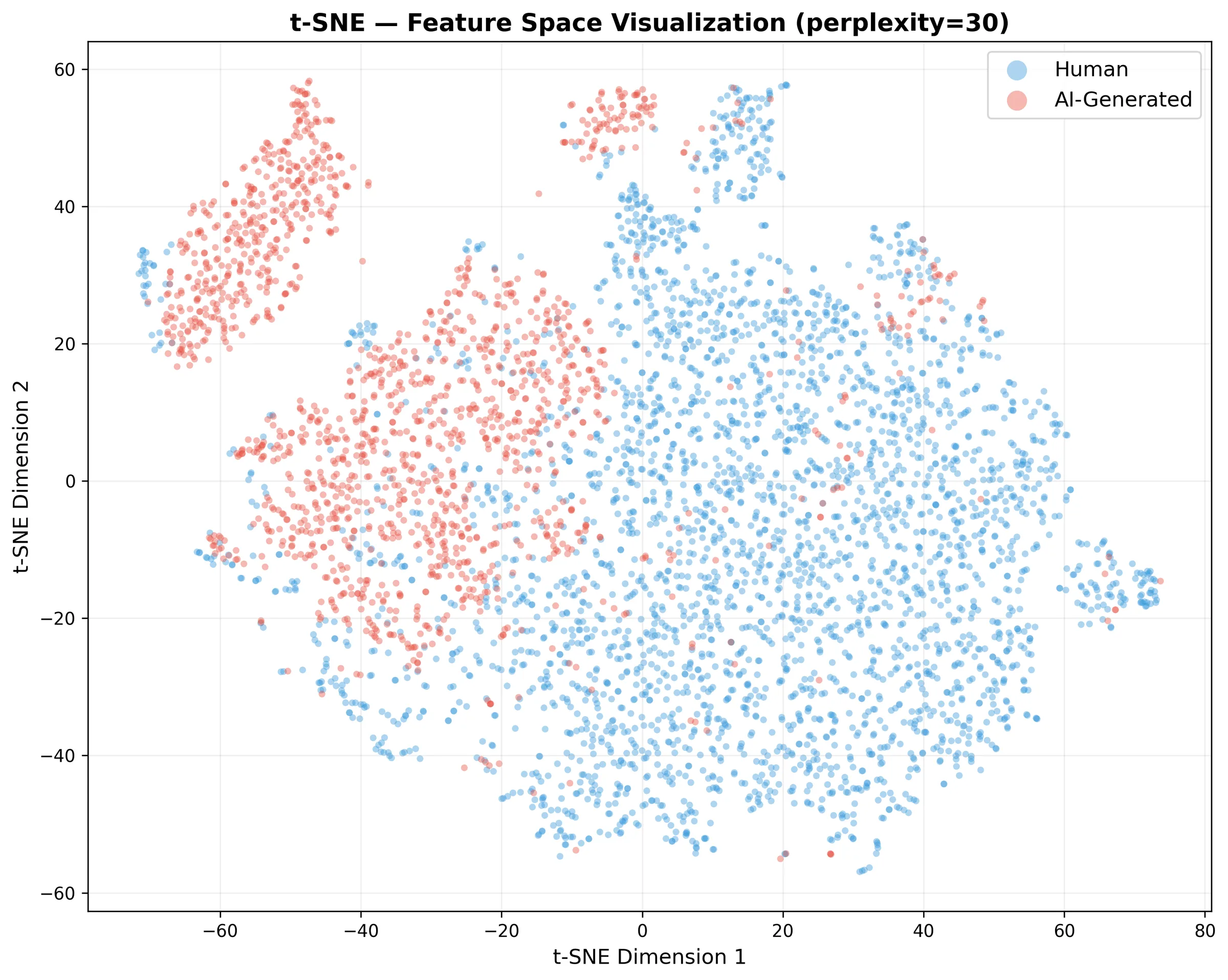
Random Forest wins because it models non-linear feature interactions via bootstrap aggregation of 200 trees, capturing the complex geometry visible in the PCA and t-SNE projections that a single linear boundary cannot.
The honest finding: detection does not generalize
The scientifically important result is a failure. When I took the HC3-trained models (trained only on ChatGPT text) and evaluated them on M4/SemEval-2024, generalization collapsed. On Bloomz-generated text, every classifier fell to 20-30% accuracy, worse than chance, with models predominantly labeling Bloomz text as human. On a multi-generator subset, accuracy recovered to 76-80% but only because the subset was ChatGPT-heavy and class-imbalanced.
The lesson is that statistical features capture generator-specific patterns, not a universal human-versus-machine boundary. Each LLM has its own training data, architecture, and decoding strategy, and therefore its own statistical profile. This aligns with theoretical work on the limits of AI-text detection, and it is exactly the kind of negative result that a pitch deck would hide and a research report should headline.
Why this design
Unlike transformer-based detectors that need GPU inference, this feature-based pipeline runs efficiently on CPU, which makes it practical for resource-constrained deployment. The playground lets you explore the feature importances, the HC3 benchmark, and the cross-generator gap interactively.
stack
the evidence